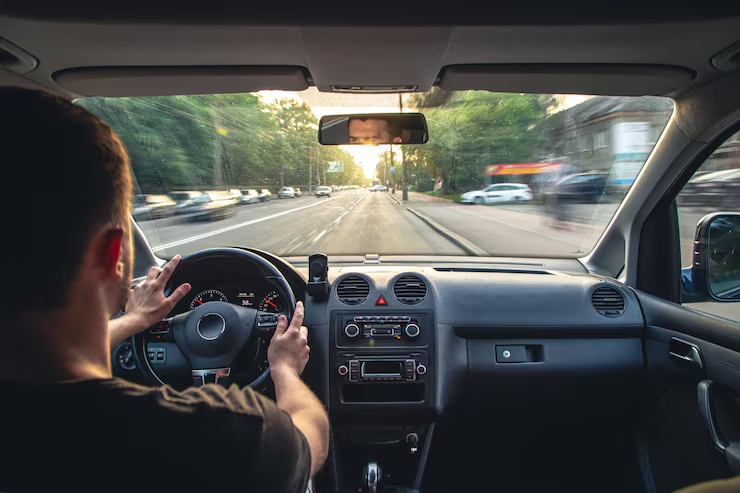
Fast Decisions on Roads and Fast Bets on Screens
There is a unique kind of pressure that comes with making decisions quickly. Whether someone is navigating a busy highway or interacting with a fast-moving casino interface, the brain is placed into a state where it must process information, react, and act within seconds. These moments feel normal in real time, yet they activate powerful mental shortcuts that shape behavior over the long term.
At first, driving and screen-based betting may seem unrelated. One involves physical movement through space, the other digital interaction. But when we look closely at how speed influences human thinking, the connection becomes clear. Both environments push the mind toward rapid responses, reducing the space for reflection and increasing reliance on instinct.
How Speed Rewires Decision-Making
Psychologists often describe two systems of thinking:
- Fast thinking (automatic, instinctive)
- Slow thinking (deliberate, analytical)
In high-speed environments, fast thinking takes over.
Research shows:
- People under time pressure are up to 45% more likely to rely on instinct rather than logic
- Decision accuracy can drop by 20–30% when response time is limited
On the road:
- Drivers react to sudden lane changes, signals, or braking.
- There is no time to analyze every option.
On a casino screen:
- Outcomes appear instantly.
- New decisions are presented immediately.
A user from a driving forum once shared:
“You don’t think through every move—you just react. It becomes automatic after a while.”
A similar comment appears in gaming communities:
“After a few rounds, you stop thinking about each bet. You just go with the flow.”
This shift is not accidental. It is how the brain adapts to speed.
Continuous Flow Reduces Reflection

Both roads and digital betting systems are designed around continuous movement.
In driving:
- Traffic flows constantly.
- Signals, vehicles, and road conditions change without pause.
In digital betting:
- Results appear instantly.
- The next action is always available.
This uninterrupted flow has a powerful effect:
- It removes natural stopping points
- It discourages reflection
- It creates momentum
A transport behavior study found:
- Drivers are less likely to reassess decisions during continuous traffic flow
- Players are 35% more likely to continue interacting when there are no pauses between outcomes
A real user observation captures this perfectly:
“The hardest part is stopping. Once you’re in the rhythm, it feels easier to keep going.”
The absence of breaks turns action into habit.
Repetition Builds Confidence in Speed
When quick decisions are repeated often, they begin to feel natural—and even comfortable.
This leads to an important psychological shift:
Speed becomes associated with competence.
In driving:
- Experienced drivers react faster.
- Quick reactions feel like skill.
In gambling:
- Rapid decisions feel efficient.
- Acting quickly feels like confidence.
A behavioral study found:
- Repeated fast decision-making increases perceived confidence by 25%, even without improved outcomes
Driver perspective:
“I trust my instincts now. I don’t need to think as much.”
Player perspective:
“You get used to making quick calls—it feels like you know what you’re doing.”
But this confidence can be misleading.
Because while speed feels like mastery, it often reduces careful evaluation.
Emotional Influence in High-Speed Environments
Speed does more than affect thinking—it amplifies emotion.
When decisions happen quickly, there is less time to regulate feelings. Emotions move directly into action.
Research highlights:
- Emotional reactions influence over 60% of rapid decisions
- High-speed environments increase impulsive behavior significantly
On the road:
- Frustration can lead to aggressive driving
- Urgency can lead to risky maneuvers
On screens:
- A win can trigger excitement → faster decisions
- A loss can trigger urgency → immediate response
A player described it this way:
“When things happen fast, you don’t sit with the feeling—you just act on it.”
This creates a loop:
- Fast outcome
- Emotional reaction
- Immediate next decision
Over time, this loop becomes automatic.
The Illusion of Efficiency

One of the most subtle effects of fast decision-making is the illusion of efficiency.
People often believe:
- Faster decisions = better performance
- Less hesitation = more control
But studies show:
- Slower, deliberate decisions often produce better long-term outcomes
- Fast decisions increase the likelihood of repeating mistakes
In driving:
- Quick reactions are necessary—but overconfidence can reduce safety
In gambling:
- Fast decisions feel productive—but may reduce awareness
A user insight reflects this clearly:
“It feels like you’re doing more when you go fast, but you’re not always thinking better.”
Speed creates a sense of momentum, not necessarily improvement.
Why the Brain Adapts to Speed
The brain adapts to fast environments because it seeks efficiency.
When exposed repeatedly to rapid decision-making:
- It builds shortcuts (habits)
- It reduces cognitive effort
- It prioritizes speed over depth
This adaptation is useful—but it comes with trade-offs.
A neuroscience study found:
- The brain reduces activity in analytical regions during repeated fast decisions
- Habit-based regions become more active over time
In simple terms:
The more we act quickly, the less we analyze.
Key Insight: Speed Shapes Behavior More Than We Realize
There is a simple but powerful truth behind all of this:
Speed does not just affect how fast we act—it changes how we think.
Across both driving and digital betting:
- Fast environments encourage instinct over analysis
- Continuous flow reduces reflection
- Repetition builds confidence in quick decisions
- Emotions gain stronger influence
These elements combine to create patterns that feel natural, even when they are complex.
Final Reflection
Fast decisions are not inherently good or bad—they are part of how humans adapt to dynamic environments. But when speed becomes the default, it can quietly reshape behavior in ways that go unnoticed.
Understanding this connection offers something valuable: awareness.
Because once a person recognizes how speed influences their thinking, they gain the ability to pause—even briefly—and bring clarity back into the process.
In the end, whether on the road or on a screen, the real skill is not just reacting quickly, but knowing when to slow down.